Your interior designer recommended automated shading for every window. Your builder added it to the bid. And you looked at the line item and thought: Do I really need to spend six figures on window treatments?
It’s a fair question. Motorized shading represents one of the larger investments in a luxury home project, and unlike a kitchen remodel or a home theater, the value isn’t always obvious at first glance. But in Colorado, the math tells a story that changes the conversation entirely.
This isn’t about convenience or aesthetics, though you get both. It’s about quantifiable financial returns that compound every year your home stands in the mountain sun.
Colorado’s Sun Is Different
Most ROI calculations for motorized shading assume average U.S. conditions. Colorado isn’t average.
At 5,280 feet in Denver, UV radiation runs 36% higher than sea level. At 9,000 feet on the slopes, that number climbs to 42%. The state logs over 300 days of sunshine annually, and during winter months, snow reflection amplifies UV exposure by an additional 40-60%.
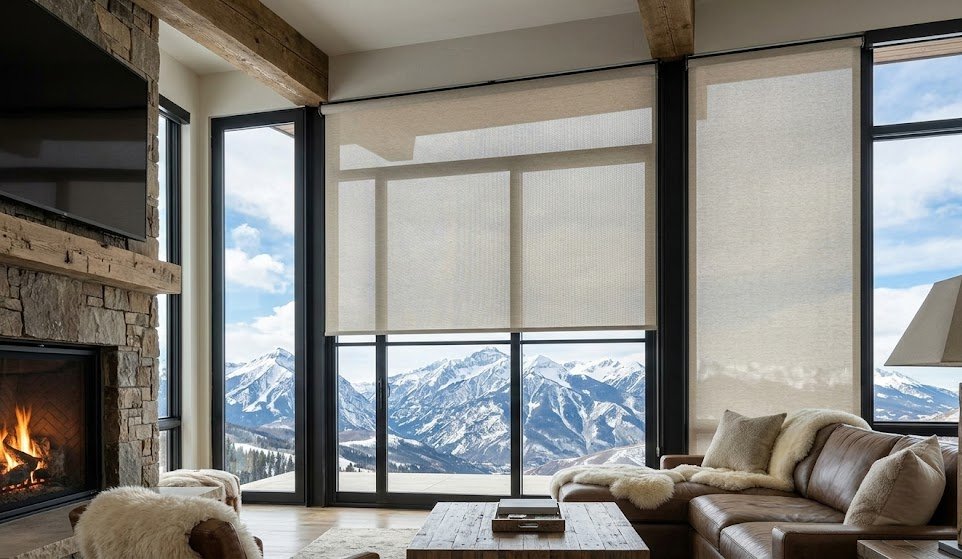
Now consider what that sun hits inside a typical mountain home. Floor-to-ceiling glass walls designed to capture views also capture massive amounts of solar energy and UV radiation. Reclaimed hardwood floors. Natural fiber rugs. Original artwork. Custom upholstery in materials selected for texture and warmth, not UV resistance.
Without automated protection, those materials degrade faster than most homeowners realize.
The Three Financial Returns
Motorized shading delivers ROI through three distinct channels, each measurable on its own. Together, they build a compelling financial case.
1. Energy Savings: 15-25% Cooling Load Reduction
Automated shading systems reduce cooling loads by blocking solar heat gain during peak hours. In a Colorado mountain home with extensive glass, that translates to meaningful savings.
Here’s how the numbers work for a typical 8,500 square-foot property:
The system tracks the sun’s position using an astronomical timeclock, adjusting shades throughout the day based on solar angle, not just time of day. During summer months, west-facing glass gets protection starting in early afternoon. South-facing windows receive dynamic management as the sun arcs overhead. East-facing glass gets morning coverage that opens as the sun moves past.
Winter performance matters equally. Rather than simply blocking sunlight year-round, smart shading allows morning solar gain to warm south-facing rooms passively, then blocks harsh afternoon glare from low-angle western sun. This seasonal optimization reduces heating costs while preventing the glare that makes rooms unusable during Colorado’s brilliant winter afternoons.
For homes with electric heating and cooling, annual energy savings typically range from $10,000 to $20,000 on properties over 8,000 square feet. The percentage reduction holds across different HVAC configurations, though the dollar impact varies with utility rates and system type.
When integrated with lighting control, the savings compound further. Daylight harvesting automatically dims electric lighting when natural light provides sufficient illumination, reducing lighting energy consumption without any occupant effort.
2. Preservation Value: Protecting Five- and Six-Figure Investments
This is where Colorado’s altitude creates an outsized financial impact.
UV radiation doesn’t just fade fabrics. It breaks down molecular bonds in organic materials. At Colorado elevations, that process accelerates significantly compared to sea-level homes. A hardwood floor that might show sun damage after eight years at sea level can begin showing wear in three to four years at 9,000 feet without proper UV management.
Consider what’s at stake in a typical luxury mountain home:
Reclaimed or wide-plank hardwood flooring might represent a $150,000-$300,000 investment across common areas. Custom area rugs in natural fibers can run $10,000-$50,000 each. Original artwork, depending on the collection, carries values that need no elaboration. Custom upholstered furnishings in a great room alone often exceed $75,000.
Automated shading extends the functional life of these materials by 200-300% compared to unprotected exposure. That’s not a vague estimate. UV damage follows predictable exposure curves, and reducing cumulative exposure by managing the most intense hours produces measurable results.
For a home with $500,000 in UV-vulnerable interior investments, avoiding even one premature replacement cycle over a decade represents a return that exceeds the shading system cost.
Interior designers understand this equation well. Many specify automated shading not just for light control and aesthetics, but specifically to protect the material selections they’ve carefully curated for a project. When a designer recommends motorized shading, preservation value is often driving that recommendation as much as visual comfort.
3. Property Value and Marketability
Automated shading has become an expected amenity in Colorado’s luxury market. Buyers evaluating properties in the $5M-$20M+ range increasingly view comprehensive automation, including shading, as standard rather than premium.
The absence of automated shading in a high-end mountain home raises questions for sophisticated buyers. It suggests either a lack of attention to technology integration or, worse, years of unmanaged UV exposure on interior finishes.
Green building certifications, increasingly relevant in Colorado given the state’s aggressive greenhouse gas reduction goals, benefit from automated shading’s documented energy performance. For projects pursuing certification, shading automation provides quantifiable credits toward efficiency targets.
The Second-Home Advantage
Colorado’s vacation property market creates a unique shading ROI scenario that most national calculations miss entirely.
With vacancy rates reaching 36% in Eagle County and over 60% in some resort communities, mountain properties sit empty for months at a time. During those vacant periods, automated shading operates on aggressive protection schedules impossible in an occupied home.
When no one needs to see through the windows, the system defaults to maximum UV blocking on sun-exposed facades, then opens shades on cloudy days or during periods when solar angle doesn’t threaten interior materials. This vacancy-optimized programming dramatically reduces cumulative UV exposure while maintaining some natural temperature regulation.
Savant and Crestron platforms enable these automated schedules through remote management. Homeowners don’t need to think about it. The system protects the home whether the owner is in residence or away for six months.
Geofencing adds another layer of intelligence. As owners approach their mountain property, the system transitions from protection mode to welcome mode, opening shades to reveal views and adjusting lighting for arrival. The home feels lived-in the moment you walk through the door.
Seasonal Performance in Practice
Motorized shading in Colorado isn’t a single-season solution. Each season presents distinct conditions that automated management addresses differently than static or manually operated treatments.
Summer brings intense direct sun and long days. The system blocks western exposure starting mid-afternoon and manages south-facing glass throughout the day. Energy savings peak during this period.
Fall offers lower sun angles that penetrate deeper into rooms. The system adjusts tracking to address this changing geometry, protecting furniture and floors from angles that weren’t a concern in July.
Winter presents Colorado’s most complex shading challenge. Snow reflection intensifies UV exposure while low sun angles create blinding glare. At the same time, passive solar gain reduces heating costs. The system balances these competing priorities automatically, allowing warming solar energy while blocking damaging UV wavelengths and managing glare.
Spring transitions between winter and summer modes, with rapidly changing conditions day to day. Weather-responsive operation adjusts for cloud cover, late-season snow reflection, and the strengthening sun angle.
No homeowner will manually adjust shading across 30-50 windows to optimize for these seasonal shifts. Automation makes the performance possible.
What the Numbers Look Like
For a Colorado mountain home in the 8,000-12,000 square foot range with significant glass exposure, a comprehensive motorized shading system typically represents a $75,000-$150,000 investment depending on window count, fabric selections, and system complexity.
Against that investment, consider the annual returns:
Energy savings of $10,000-$20,000 annually on properties with electric HVAC. Interior preservation value averaging $15,000-$30,000 per year when measured against accelerated replacement cycles without protection. Property value contribution that’s difficult to isolate but consistently reflected in comparable sales data.
Conservative estimates place the payback period at five to eight years when combining energy and preservation returns. Properties with extensive art collections, high-value flooring, or extreme UV exposure at the highest elevations may see faster returns.
Compared to alternative approaches for achieving similar energy performance, like upgrading to triple-pane glass throughout or adding exterior fixed shading structures, automated interior shading delivers comparable or superior results at lower cost while adding flexibility and control that fixed solutions can’t match.
What Architects and Designers Should Know
For design professionals specifying shading on Colorado projects, timing matters as much as product selection.
Motorized shading requires electrical rough-in at every window location during framing. Adding motorization power after drywall increases costs by 400-600% for retrofit wiring and finish repair. On a 40-window mountain home, that timing difference alone can represent $30,000-$50,000 in unnecessary expense.
The specification process works best when the integrator joins the project during design development, not during finish selections. At that stage, electrical plans can incorporate motorization power alongside standard lighting circuits. Structural backing for hardware gets coordinated with framing drawings. Control wiring routes through walls alongside other low-voltage infrastructure.
When architects engage the integration team early, the shading system integrates seamlessly with the architectural vision rather than being retrofitted around completed construction. Fabric pockets get designed into ceiling details. Hardware mounting aligns with window trim profiles. Control interfaces coordinate with the overall interior design language.
Making the Decision
The question isn’t really whether motorized shading delivers financial returns in Colorado. The math supports it clearly, especially at altitude where UV intensity and sunshine days compound the benefits.
The real question is whether to invest during construction or add it later. And that answer is straightforward: early specification costs significantly less, performs better, and integrates more cleanly with both the architecture and the whole-home automation system.
For homeowners weighing the investment, ask your design team for a project-specific analysis. The variables that matter most are window count and orientation, elevation, interior material values, and HVAC configuration. With those inputs, the ROI calculation becomes specific to your property rather than theoretical.
For architects and builders guiding clients through this decision, the preservation argument often resonates most strongly. Homeowners who hesitate at energy savings projections respond differently when they understand the UV exposure their $200,000 in reclaimed flooring will absorb without protection.
The sun that makes Colorado spectacular is the same sun that demands intelligent management. Motorized shading delivers that management while paying for itself in the process.