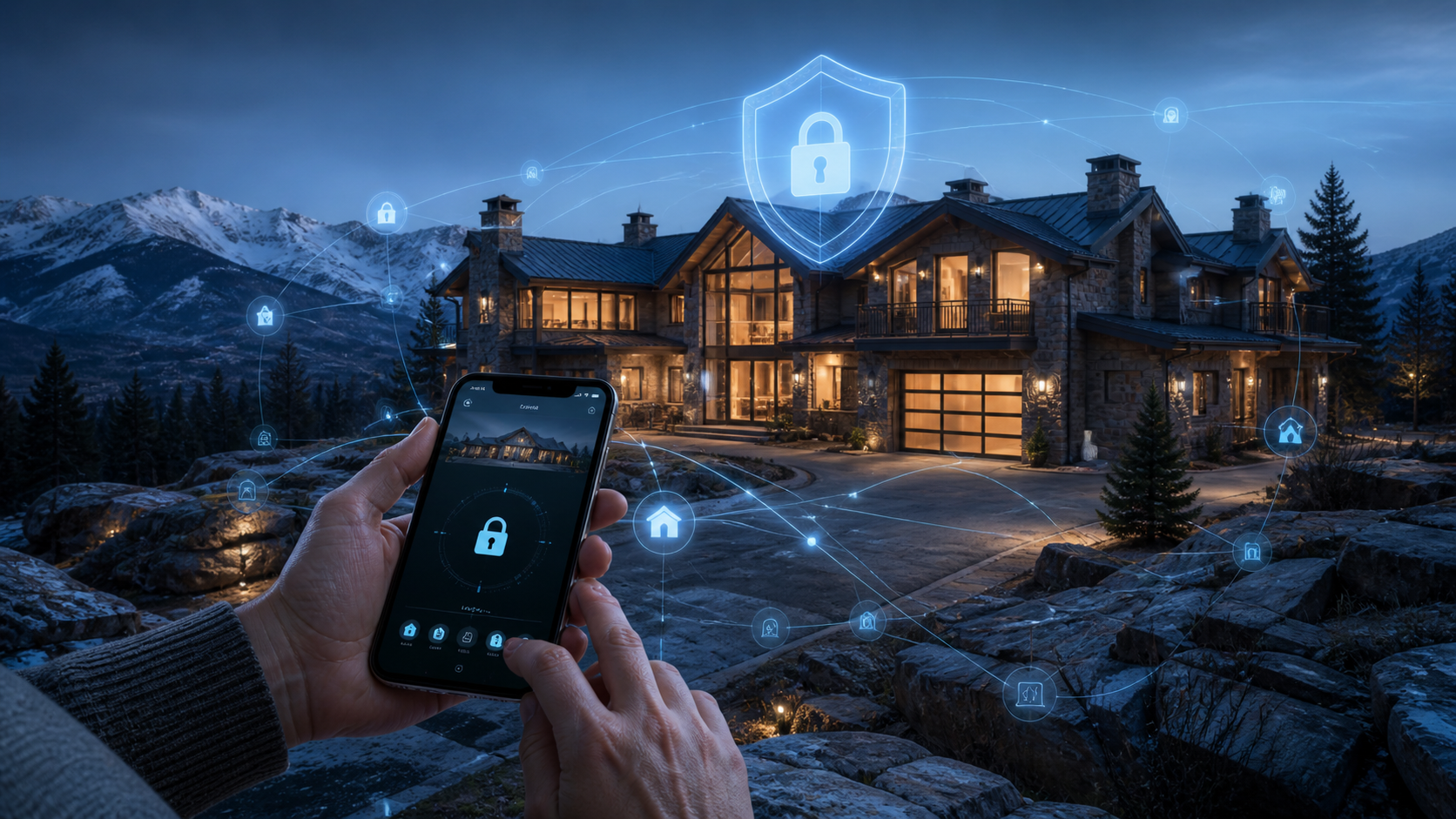
A homeowner returns to her Colorado mountain residence after six weeks abroad. The alarm system reports no incidents. The cameras show clean footage. The smart locks logged only the housekeeper’s expected visits. Everything looks fine.
What she doesn’t see: someone has been watching her cameras for two months. They know her arrival window. They know which rooms she uses. They know when the housekeeper comes and goes. The breach didn’t trigger an alarm because nothing was broken into. The intruder simply logged into a system that was never properly secured in the first place.
This scenario is not hypothetical. It happens because the connected home as a category has outpaced the security thinking that should accompany it. Luxury homeowners invest heavily in physical protection. Reinforced doors, monitored alarms, gated entries, on-site staff. Far fewer extend that same rigor to the digital systems that increasingly run their homes.
That gap deserves attention.
Why Connected Homes Are Attractive Targets
A modern luxury residence routinely operates 50 to 100 connected devices. Cameras, door locks, climate controls, audio systems, lighting processors, motorized shading, irrigation, water detection, EV chargers, voice assistants, network appliances. Each device is an entry point. Each runs software that requires updates. Each communicates over a network that may or may not be properly segmented.
The luxury second-home market amplifies the problem. Properties in Colorado’s resort communities sit empty 36 to 66 percent of the year. During those long absences, the digital systems are the security layer. Cameras are watching. Locks are listening for valid credentials. Climate sensors are reporting. If those systems are compromised, there is no human in the house to notice.
The motivations behind these attacks fall into a few categories worth understanding.
Property reconnaissance. Compromised cameras give an attacker a calendar. They learn occupancy patterns, vendor schedules, family routines, and arrival logistics. That intelligence is useful for theft, but it is also sold.
Direct property access. Smart locks with weak authentication or unpatched firmware can be opened remotely. A criminal who controls the lock controls the front door.
Privacy invasion. Cameras, microphones, and voice assistants can be hijacked for surveillance. For high-profile clients, that data has resale value.
Ransomware and extortion. Attackers increasingly target home automation systems directly, locking owners out of their own controls and demanding payment to restore access. The home theater stops working. The lights won’t respond. The thermostat is frozen at 95 degrees in July.
Network pivot attacks. A compromised smart device can become a foothold into more sensitive systems on the network, including business email, financial accounts, and family members’ personal devices.
None of these scenarios require the criminal to be physically near the property. That is the point.
Where Residential Networks Typically Fail
Most luxury homes are protected by the same class of network equipment found in suburban subdivisions. The internet provider drops off a consumer router. A few mesh access points get added. Devices connect to a single flat network. Everything talks to everything else.
This works fine for browsing the web. It is wholly inadequate for a home that contains 75 connected devices, several of which are made by companies whose security practices range widely.
Three architectural failures show up consistently.
No segmentation. When the smart refrigerator and the security camera and the family laptop all share one network, a vulnerability in any device potentially exposes all of them. A camera firmware flaw becomes a pathway to email accounts.
No active management. Consumer routers do not provide visibility into what devices are doing, what they are connecting to externally, or whether their behavior has changed. The network is essentially invisible to the homeowner.
No professional patch discipline. Devices ship with security updates throughout their lifecycle. Without someone responsible for tracking and applying those updates, vulnerabilities accumulate. The home gets less secure each year, not more.
Solving these requires a different infrastructure category entirely.
The Architecture That Actually Protects
Properly secured connected homes look more like small enterprises than residential installations. The components are mature. The discipline is what makes them effective.
Network segmentation through VLANs. A well-designed luxury home runs at least four separate virtual networks: a control network for the automation processors and trusted devices, an IoT network for cameras and connected appliances, a guest network for visitors, and a primary network for the family’s personal computing. These networks cannot freely communicate with each other. A compromised security camera on the IoT VLAN cannot reach the family’s banking session on the primary network.
Ruckus access points and Araknis managed switches make this kind of segmentation practical at the residential scale. The hardware enforces the boundaries that the architecture defines.
Enterprise-grade firewalling. Fortinet firewalls bring intrusion detection, threat intelligence feeds, and outbound traffic inspection that consumer routers simply do not perform. When a compromised device tries to phone home to a known malicious server, the firewall blocks it and alerts the integrator. This is the difference between hoping nothing goes wrong and being notified when something does.
Secure remote access. Property owners and managers need to reach their systems from anywhere. The wrong way to enable that is to expose devices directly to the internet. The right way is a VPN that requires multi-factor authentication, with all remote management traffic flowing through the encrypted tunnel. Crestron, Savant, and Control4 all support this architecture when it is properly configured. They are also commonly misconfigured, which is one of the most common findings during a security audit.
Power and connectivity monitoring. WattBox network management appliances provide visibility into what devices are online, when they reboot, and how the network is performing. This sounds mundane. It is also how integrators detect early signs of trouble, including devices that fall offline at suspicious times or behave outside their normal patterns.
Device-Level Discipline
Network architecture establishes the perimeter. Inside that perimeter, individual devices still require attention.
Cameras and microphones deserve particular care. Axis IP cameras, when properly configured, support strong authentication, encrypted streams, and fine-grained access controls. The same hardware run with default passwords and open ports becomes a liability. Configuration is the entire story.
For the most sensitive spaces, physical microphone disconnects on voice assistants are worth specifying. A home office where confidential calls happen, a bedroom, a private study. The hardware switch is a guarantee that no software bug or remote compromise can override.
Smart locks demand the strongest authentication available. Multi-factor where the platform supports it. Unique codes per user, with logging. Codes that get revoked the day a relationship ends, not whenever someone remembers.
Firmware updates are not optional. Every connected device should be on a tracked update schedule, with someone accountable for applying patches. This is one of the clearer reasons to work with an integrator who provides ongoing management rather than treating the system as a one-time installation.
Managing Property Access Without Compromising Security
Luxury properties accommodate a steady flow of authorized visitors. Housekeepers, property managers, contractors, family members, guests, vendors. Each needs some level of access. None should have unlimited access indefinitely.
Thoughtful design separates access from credentials. A property manager does not need administrative control of the automation system to verify that the heat is running. A housekeeper does not need camera access to enter through a side door. Granular permissions, scoped to the actual job, reduce exposure when something goes wrong.
Time-bounded access matters as well. Codes that expire automatically. Remote access that gets revoked when a contract ends. Activity logs that record who did what, when. None of this requires extraordinary effort once the underlying platform supports it. All of it requires that the platform was selected and configured with these capabilities in mind.
For families with significant staff turnover or high visitor volume, biometric authentication at primary entries adds another layer. Fingerprint and facial recognition platforms have matured considerably. The authentication is harder to share, harder to lose, and harder to copy than a code or key.
What Happens When Something Goes Wrong
Even well-secured homes occasionally face incidents. A device gets compromised. A credential leaks. A vendor announces a vulnerability that requires immediate patching. The question is not whether incidents will occur but whether the home is positioned to respond quickly.
Three capabilities make response possible.
Backups of system configurations. When automation programming is properly backed up, a compromised processor can be restored to known-good state in hours rather than days. This includes lighting scenes, audio zones, control logic, and integration settings.
Documented incident contacts. The homeowner should know exactly who to call when something looks wrong, before something looks wrong. The integrator’s response capability, the network specialist’s after-hours coverage, the manufacturer’s security team, the insurance carrier’s cyber line. Having this information assembled in advance shortens response time materially.
Insurance alignment. Cyber incidents involving connected homes are an evolving area of coverage. Standard homeowners policies may or may not respond. High-net-worth carriers increasingly offer cyber-specific endorsements. This is worth a conversation with the family’s insurance advisor while the home is being designed, not after a claim arises.
A Different Kind of Security Conversation
The instinct to think about home security in physical terms is reasonable. Doors, windows, alarms, monitoring services. These remain essential. But the surface area of a connected luxury home now extends well beyond the property line. The attackers who pose the most sophisticated threats never set foot in Colorado.
That reality calls for a security conversation that includes the digital infrastructure with the same seriousness applied to physical protection. Network architecture as a designed system, not a side effect of internet service. Device discipline as an ongoing practice, not a one-time setup. Access management as policy, not convenience. Incident response as a plan, not an afterthought.
For homes that already operate substantial automation, a cybersecurity assessment is the practical starting point. The work involves auditing the existing network architecture, reviewing device inventories and firmware status, evaluating remote access configurations, and identifying the gaps that matter most. The findings tend to surprise people. They are also actionable, which is the point.
The connected home is here to stay. Treating its security with the rigor the underlying investment deserves is what separates protection from the appearance of it.
Ready to evaluate your home’s digital security posture? Our network specialists conduct cybersecurity assessments specifically designed for connected luxury residences. We audit your current architecture, identify vulnerabilities, and recommend the infrastructure upgrades that protect both your property and your privacy. Reach out to schedule a confidential consultation.